
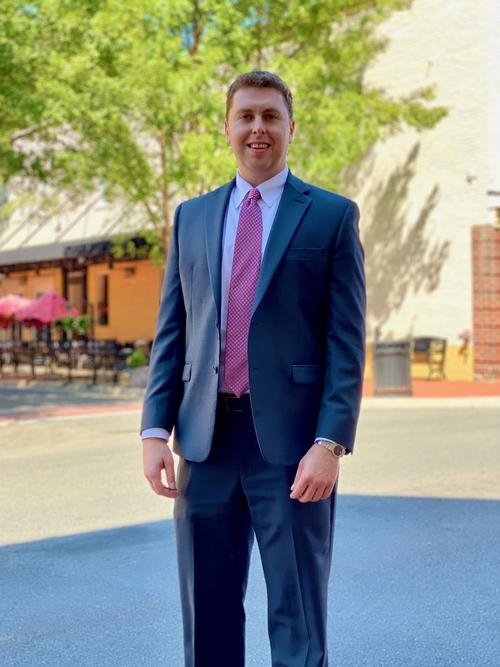
Attorney Casey J. Bach represents clients charged with DUI/DWI, criminal offenses, and serious traffic charges in jurisdictions throughout Virginia. Mr. Bach studied Law and Society at American University before graduating from George Mason University School of Law.
Before joining The Wilson Law Firm, Mr. Bach practiced both criminal defense and immigration law at other Virginia law firms and litigated dozens of hours-long asylum hearings at the Arlington Immigration Court. This experience not only sharpened his trial skills but also helped him learn to connect with clients personally to best represent the most intimate and complex details of their cases. His time representing Immigration Court clients also enabled him to become conversational in Spanish, and he is still happy to assist Spanish-speaking clients.
Since joining the firm in 2021, Mr. Bach has handled more than 1,300 matters and counting, including over 500 reckless driving cases. He represents both adults and juveniles, and his practice spans the criminal justice system from minor traffic infractions through serious felonies, including violent crime, larceny, drug and firearms offenses, hit and run, and probation violations. He has helped clients get charges ranging from violent felonies to petty larceny to reckless driving dismissed by the court or reduced to lesser offenses.
Mr. Bach also represents clients who are under investigation but have not been charged, when what happens before an arrest can determine whether one occurs. He handles appeals, and he has helped clients clear their records and restore what a conviction took from them through expungement, restoration of firearm rights, and restoration of driving privileges.
His DUI practice runs from first offense through third and subsequent offenses. He has had DUI charges dismissed both by the court finding his clients Not Guilty at trial and by motion of the prosecution to nolle prosequi, or voluntarily dismiss the charges without trial.
To better represent his DUI/DWI clients, Mr. Bach completed the NHTSA 24-hour course on administering Standardized Field Sobriety Tests, the same training given to the police officers who conduct these tests during DUI/DWI investigations. Knowing the correct procedure helps him identify both what his client's performance actually showed and where the arresting officer departed from the standards.
He has also completed the Forensic Chromatography course offered by the American Chemical Society Division of Chemistry and the Law, taught at Axion Labs in Chicago. Chromatography is the laboratory method used to identify and measure substances in blood and other biological samples, and the course covers the instruments involved, the conditions under which they produce reliable results, and the sources of error that can affect a reported concentration.


